

Aslında en çok kaçırılan nokta, dünyaya kendi çevremizden edindiğimiz kelimeler ve algılarla bakıyor oluşumuz. Burada en önemli etken kendi dilimiz ve kültürümüz. Bu yüzden bir dil bir insandır diyoruz.
Bir dili öğrenmek istiyorsanız en önemli şey onun kültür ve düşünce şekline de hayatınıza sokabilmektir ve bunu sokmadığınız kadar öğrenmek istediğiniz dili aklınıza oturtamazsınız.
Sapir-Whorf Hipotezi’ de tam olarak bunu savunup insan düşüncesinin yerel dillerden çok yoğun bir şekilde etkilendiğini göstermektir. Dilin; düşünceyi, kişinin dünyayı kavrayış biçimini belirlemesini ve farklı diller, farklı düşünceleri kodlar mantığını savunur.
Burada benim için gözden kaçırılmaması gereken en önemli detay, biz aynı dilleri konuşanlar olarak benzer bir düşünce yapısına sahibiz ama bence aynı dile sahip olsak dahi yaşadığımız çevrenin hatta ondanda öte kendi düşüncelerimizde olan algıların farklılığından hiç bir zaman karşımızdakini tam anlayamayız, bu da başkaları tarafından anlaşılamamızın cevabıdır.

Olaya büyük resimden bakarsak, misal İngilizce konuşan birisi yazıldığı gibi okunmayan bir kelimeyi telaffuz ederken Türkler gibi o an düşünmüyor. Endonezce’de zaman bildirimi yüklemde yapılmıyor. Rusça’da ise zamanı, cinsiyeti ve de eylemin sona erip ermediğini tek bir yüklemden anlayabiliyoruz. Örneğin Türkçe’de ise yüklem bilgiyi duyup mu yoksa görüp mü elde ettiğimizi ve öznenin kim olduğu gibi detayları paylaşıyoruz.
Yani aslında benzer şeyleri anlatsak da anlatış şeklimiz ve o an düşüncelerimiz farklı. Örneğin Aborjinlerde sağ-sol-ileri-geri kavramları yok. Onlar için doğu-batı-kuzey-güney var ve doğa-batı zamansal çizgidir. Bu ise yön algısının komple değişmesi demektir. Siz masadaki saati uzaydaki konumuyla sağ köşede baz alırken onlar ise bulundukları konuma göre değerlendirecektir. Yine İngiliz kaynaklı haberlerde veya filmlerde görmüşüzdür, saat 8 yönünde bir polis aracı yoldan geçiyor. Bu bizim düşünce yapımıza terstir bu yüzden navigasyonu algılamamızda zor olandır.
Örneğin küçüklükten şimdiki yaşınıza bir fotoğraf sıralaması isteseniz Aborjinler bunu o anki durduğu konuma göre yapar, misal doğu yönüne yüzü bakıyorsa fotoğrafları diklemesine kendine gelecek şekilde sıralar, Arap’lar ise bizim tersimiz sağdan sola doğru sıralar.
Bundan da farklı olarak örneğin düşünce sistemlerimiz ve zamansal algılayışımız yataysal boyutta, bu yüzden “önümüzdeki sene”, “geride kalanlar” diyoruz ama bir Mandarin’li için bu dikeysel boyutta olduğundan “aşağıdaki sene”, “yukarıda kalanlar” oluyor. Bir diğer etkende artikeller, misal Almanca daha Maskülen, İspanyolca ise daha Feminen bir dil, burada algı olarak ortak kelime birisi için çok naif olarak düşünülürken diğeri için çok keskin algılanabiliyor.
Kısacası kullandığımız dil yapısı aslında düşünce sistemimizin bir izidir ve bu da kültürümüzle ilişkilidir. Dil öğrenilirken en çok atlanılan nokta o dilin kültürü ve düşünce yapısı bağlamında düşünemediğimizden o dili algılayamayışımızdır. Bu yüzden hiç bir translate demek istediğimizi tam çeviremeyecektir. Ki aynı dili paylaşsak dahi bir de bireysel kendi dilimiz ve düşünce şeklimiz ile ortaya çıkan sonuç izafiyeti derinleştirmektedir.
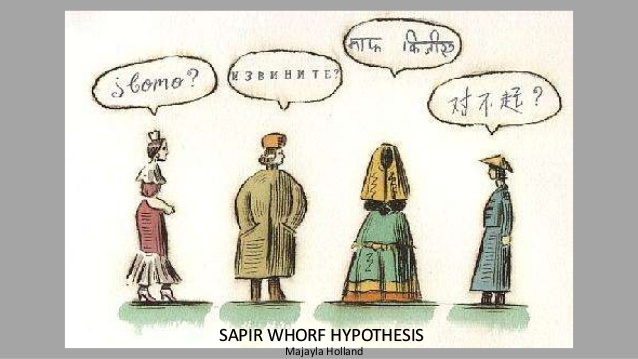
Sapir Whorf Hypothesis / Linguistic Relativity
In fact, the most misplaced point is that we are looking at the world with words and perceptions we have taken from our own surrounder. The most significant factor here is our own language and culture. Therefore we call in Turkish that if you know one language you are one person.
If you want to learn a new language, the most important thing is to be able to put your life in the way of culture and system of thought for that tongue. As long as you don’t put this in, you can’t settle your language mind that you want to learn.
In Sapir-Whorf Hypothesis, it is precisely this that has shown that human thought is heavily influenced by mother tongue Languages, the idea is that someone can determine the way of comprehending the world and allege the logic of different languages and different ideas.
The most key detail that shouldn’t be missed here for me is that we have a similar mindset as speakers of the same language in Turkish but I think we can’t fully understand the difference between the perceptions that we have in our own thoughts, and even the ones we have the similar surrounder, even if we share the same language, this is the answer of our incomprehension by others.

Someone who speaks English doesn’t think as a Turk at that time when they pronounce a vocabulary that doesn’t read as written. In Indonesia, the time notice isn’t included in the verb. In Russian, you would understand clearly the notification regarding time, gender or both the process finished or continue from only verb. For instance, in Turkish, we share grammatically some details in the verb such as who is subject in that sentence, time elaborations or how we get this information by ourself or somebody.
In fact that, when we strive to discuss the similar things in spite of that fact that our perspective and the shape of explanation is pretty different from each other at that time. For instance, Aborigines do not have notions such as right-left-forward-backward. For them there is located in east-west-north-south and east & west is a temporal line. This means a completely change of directional perception for all of one. If there is a clock on the right corner in the table, the Aborigines will evaluate the position of the clock according to their own position, on the other hand, you will interpret the position of the clock according to in the location of space such as right or left. Also seen in British news or movies, for example, there is a police car drives a way which the direction is at 8 o’clock. This thinking is pretty difficult for Turkish, in this context, also the usage of navigation for car is difficult in our perception when the directive called the way with this clock method.
For example, if you want a photograph collocation from childhood to today, Aborigines will do this according to their own position during that time. If the location of their face looks east, the photos will be arranged in a way that will come to you, and the Arabs will take placement the photographs from right to the left.
Beyond that, our systems of thinking and temporal perception are the horizontal dimension, so we call them such as “left behind” or “coming year”, but for the Mandarins, they are thinking these in vertical dimension, they will call it “down year” or “above behind”. Here, the common word for perception is thought to be very naive for one of languages that is in Spanish, but very sharp the same word for German.
To sum up, the language grammar we use is actually a sign of our thought system, which is related to our culture. One of the most overlooked points when learning a language is that we can’t perceive it from the native language as well as we can’t think in terms of culture and the system of thought. Therefore, any translator will not never translated completely what we mean. Even if we share the same language, the result which emerge from our own individual eyes and thoughts that will be increasing deep relativity between other.

 Esra SELVAN
Yorum bırakın